
Combi boilers typically run at 55–60°C for efficiency, sometimes lower in well insulated homes. System and regular boilers with cylinders must store hot water at 60°C or above to control Legionella risk.
Boiler temperature is often left at the factory setting after installation, even though it may not be the best for efficiency. The right setting can improve comfort, reduce gas bills and help your boiler run more efficiently. Flow temperature, hot water temperature and room thermostat settings all serve different purposes, and the ideal setting depends on your boiler type.
Key Takeaways
- Combi boilers can run at a lower flow temperature than system or regular boilers, which directly improves efficiency and can cut your gas bill.
- If your system includes a hot water cylinder, water must be stored at 60°C or above. This is a safety requirement to control Legionella, not just a suggestion.
- Any new or fully replaced central heating system in England must now be designed for a maximum flow temperature of 55°C under current Building Regulations.
What Is Boiler Flow Temperature
Boiler flow temperature is the temperature of the water leaving your boiler to heat your radiators or underfloor heating. It is different from the temperature of the hot water coming from your taps or shower.
As the heated water travels around your home, it transfers heat into each room before returning to the boiler to be warmed again. Factory settings are often around 80°C, which is higher than many homes actually need.
Lowering the flow temperature can help a modern condensing boiler run more efficiently, provided your home still reaches a comfortable temperature.
The ideal setting depends on factors such as your boiler type, radiator size and how well your property is insulated, so there is no single temperature that suits every home.
What Is Hot Water Temperature
Hot water temperature is the temperature of the water that comes from your taps, shower and bath. Unlike flow temperature, it is not the water circulating through your radiators.
How it is heated depends on your boiler type. A combi boiler heats water directly from the mains whenever you turn on a hot tap. Because there is no hot water cylinder, stored water safety rules do not apply.
A system or regular boiler stores hot water in a cylinder until you need it. To reduce the risk of Legionella bacteria, the stored water should be kept at 60°C or above, while the water reaching outlets should be at least 50°C.
Hot water temperature and boiler flow temperature are separate settings, so changing one does not automatically change the other.
Boiler Temperature vs Room Thermostat Settings
These two controls are often confused, but they do very different jobs.
Your boiler’s flow temperature controls how hot the water inside your heating system gets. Your room thermostat controls when the boiler switches on and off based on the temperature in your home.
If your room thermostat is set to 20°C, the boiler fires up until your rooms reach that temperature, then it stops. The flow temperature determines how quickly and efficiently that happens.
Turning your room thermostat down saves energy by running the heating less often. Adjusting the flow temperature changes how efficiently the boiler works while it is running. Both settings matter, and they work best when set correctly together.
What Temperature Should Your Boiler Be Set To
The right setting depends entirely on your boiler type. A combi boiler operates very differently to a system or regular boiler, particularly when it comes to hot water.
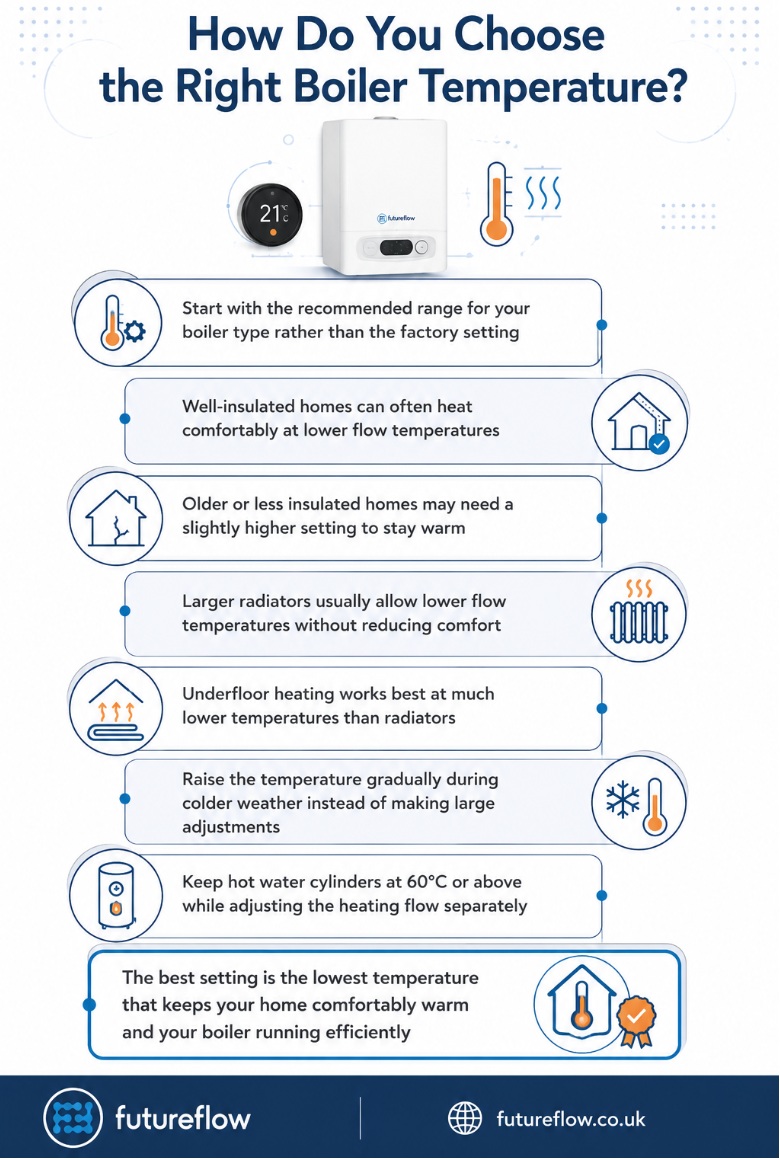
These are general guidelines. Your ideal setting will also depend on your insulation, radiator size, and how old your heating system is.
Best Temperature for Combi Boilers
Combi boilers heat water directly from the mains, so there is no stored hot water and no Legionella risk linked to the flow temperature. This gives you more freedom to turn the flow temperature down without any safety concerns.
For most UK homes, a heating flow temperature of 55–60°C is a solid starting point. Well-insulated modern homes can often run comfortably at 45–50°C.
According to the Money Saving Boiler Challenge evidence from Nesta, University of Salford Energy House testing showed that reducing flow temperature from 80°C to 60°C cut space heating gas use by 12%, saving around 9% on the total gas bill. Dropping to 55°C saved roughly 12% in total, though rooms took longer to warm up.
That is a meaningful saving just from adjusting one dial.
Best Temperature for System Boilers
System boilers work alongside a hot water cylinder, which changes the rules. The hot water side must stay at 60°C or above in the cylinder, and water must reach taps at 50°C within one minute. This is a Legionella safety requirement, not optional.
The good news is that your heating flow temperature is a separate setting. You can still optimise it for efficiency, typically in the 55–65°C range, without affecting the hot water safety temperature. The two sides of the system can be adjusted independently.
Best Temperature for Regular (Heat-Only) Boilers
Regular boilers, also called heat-only or conventional boilers, work with both a hot water cylinder and a cold water feed tank. The same Legionella rules apply to the hot water cylinder as with system boilers, so the storage temperature must remain at 60°C or above.
The central heating flow temperature is a separate control and can be adjusted independently, usually in the 55–65°C range depending on your radiators and home insulation.
Do not reduce the cylinder temperature in an attempt to save money. That is not the right dial to touch.
Recommended Hot Water Cylinder Temperature
According to the hot and cold water system safety guidance from the HSE, cylinders must store water at a minimum of 60°C, and that water must reach all outlets at 50°C within one minute of the tap being opened.
Because 60°C water at a tap is a scald risk, a thermostatic mixing valve (TMV) is fitted to blend the stored hot water with cold water before it reaches the outlet. This keeps delivery temperatures safe without reducing the cylinder storage temperature.
If your cylinder does not have a TMV, speak to a qualified engineer about getting one fitted.
How Boiler Temperature Affects Efficiency and Energy Bills
Changing the flow temperature is one of the most direct ways to affect how efficiently your boiler runs. Condensing boilers recover heat from flue gases, but only when the return water temperature drops below around 55°C. Set the flow temperature too high and the boiler never reaches that more efficient condensing mode consistently.
The main factors to consider include:
- Lower flow temperatures allow condensing boilers to recover significantly more heat from flue gases, which is where the real efficiency gains come from.
- Many boilers leave the factory set at 80°C, which is far higher than most homes need and keeps the boiler out of efficient condensing operation for much of the heating season.
- Poorly insulated homes or those with undersized radiators may genuinely need a higher flow temperature to maintain comfort, so lower is not always better.
- Heat-up time increases as flow temperature drops, so the right balance between comfort, speed, and efficiency matters for your specific household routine.
The Heating Up to Net Zero white paper from the HHIC recommends reducing mean water temperature from 70°C to 50°C in systems designed or upgraded for it, estimating gas bill savings of 6–8% for combi boiler households.
There is no single flow temperature that suits every home. The best setting is the one that keeps your home comfortably warm while letting the boiler operate as efficiently as your system and insulation will allow.
UK Building Regulations for Boiler Temperature
Since 15 June 2022, newly installed or fully replaced wet central heating systems in England should be designed with a maximum 55°C flow temperature. This applies to the whole heating system, including the boiler, pipework and heat emitters.
The aim is to help condensing boilers operate more efficiently, reduce energy use and prepare homes for future low carbon heating, such as heat pumps.
The guidance also makes it clear that 55°C is the target design temperature, but if this is not practical, the system should be designed to run at the lowest flow temperature that can still heat the property effectively.
These requirements apply only to new installations and full system replacements. Existing heating systems do not need to be altered to meet the standard.
How Boiler Temperature Settings Differ by Brand
The principles covered above apply to all boilers, but the exact default settings and the range you can adjust to will vary between brands and models. Each manufacturer sets their own factory defaults, and the controls differ between dial-based and digital systems.
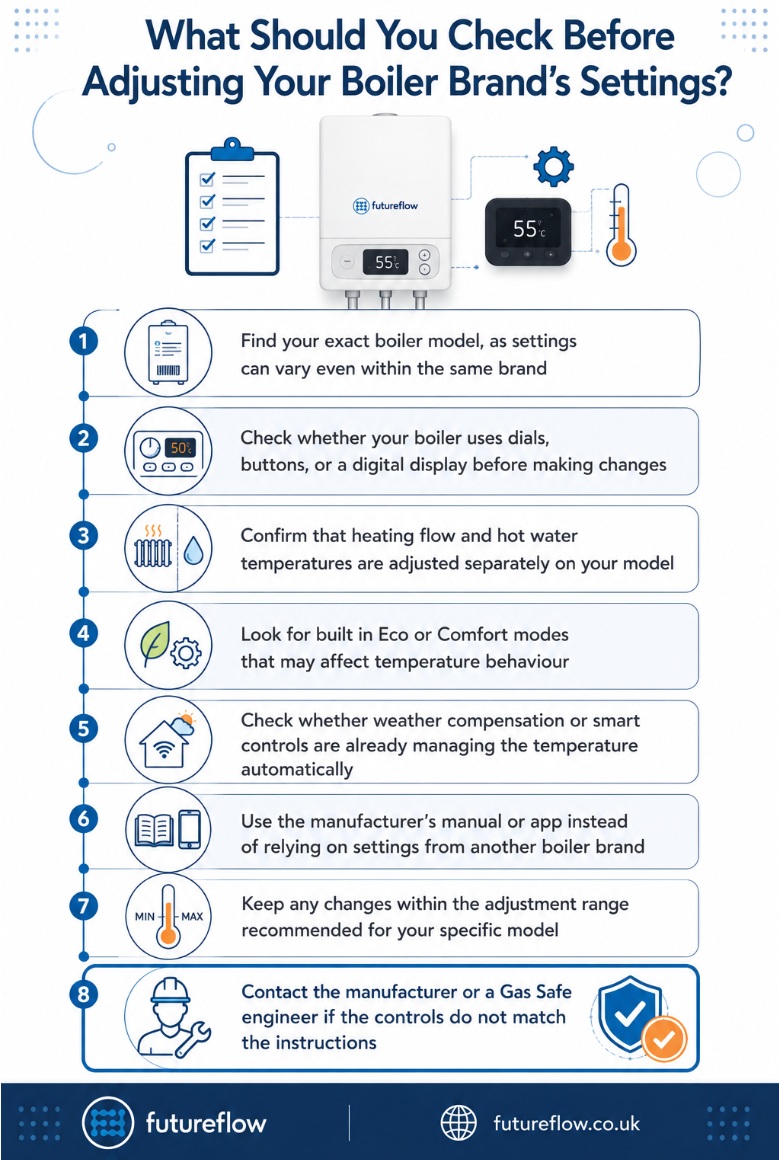
Always check your boiler’s manual or the manufacturer’s app for the exact figures for your specific model. Here is a quick overview of the main brands:
Worcester Bosch
Worcester Bosch combis, system, and regular boilers use either dial or digital controls to adjust flow and hot water temperature. Default ranges vary by model, so check the user manual or Worcester Bosch’s official guidance for your specific unit.
Vaillant
Vaillant boilers, including the popular ecoTEC range, allow temperature adjustment through the control panel or a connected app. Exact adjustable ranges differ by model, so refer to Vaillant’s official documentation for your boiler.
Ideal
Ideal boilers across the Logic and Vogue ranges have adjustable flow and hot water controls, either dial or digital. Settings vary by model, so consult the manufacturer manual for exact figures.
Baxi
Baxi combi and system boilers allow temperature adjustment directly on the control panel. Default settings and the available range differ by model, so check Baxi’s official guidance for your unit.
Viessmann
Viessmann boilers typically offer digital temperature control. The available range is model specific, so refer to the Viessmann manual or speak to your installer for exact settings.
Glow-worm
Glow-worm boilers use dial or digital controls for both flow and hot water temperature adjustment. Specifics vary by model, so check the manufacturer’s documentation for your boiler.
Alpha
Alpha boilers have adjustable temperature controls, with defaults and ranges depending on the model. Refer to Alpha’s official guidance for your specific unit.
Potterton
Potterton boilers allow temperature adjustment via the control panel. Ranges are model specific, so check the manufacturer manual before making any changes.
Vokèra
Vokèra boilers have adjustable flow and hot water temperature settings. These vary by model, so refer to official Vokèra documentation for the correct figures.
Main
Main boilers, which are a Baxi-owned brand, follow the same general adjustment principles as other combi, system, and regular boilers. Settings are model specific, so consult the manufacturer manual for your unit.
How Boiler Temperature Settings Differ by Brand
Adjusting your boiler temperature is usually straightforward, but it should always be done through the boiler’s own controls or approved heating controls. The right setting depends on your boiler type, your heating system, and the time of year.
When adjusting your boiler temperature, remember to:
- Adjust the heating flow temperature using the boiler’s dial or digital control and follow the manufacturer’s instructions for your specific model.
- Use smart thermostats or weather compensation controls where available, as these manage temperature more efficiently than manual adjustment.
- Only increase the flow temperature during colder weather if your home is genuinely not reaching a comfortable temperature, and stay within the recommended ranges for your boiler type.
- Make small adjustments and give the system time to respond before changing the setting again. One or two degrees at a time is enough.
Safe boiler temperature adjustment is about gradual changes, not jumping straight to the highest setting. If you are unsure about any controls on your boiler, check the manual first or speak to a qualified heating engineer before making adjustments.
When to Contact a Gas Safe Registered Engineer
Adjusting your boiler temperature is safe, but some problems need professional attention. If your boiler displays a fault code, locks out repeatedly or keeps losing pressure, changing the settings is unlikely to solve the issue.
You should also contact an engineer if you have no heating or hot water despite the correct settings, hear unusual noises such as banging, whistling or kettling, notice water leaking from the boiler or pipework, or spot damaged or worn components. A sudden increase in energy bills or radiators that stay cold after bleeding can also point to a fault that needs investigating.
Boiler repairs, servicing and any work involving the gas supply must only be carried out by a Gas Safe registered engineer.
If you’re experiencing any of these issues, it’s best to get a quote and have the system checked before the problem gets worse.
Whichever brand you go for, professional installation and regular servicing are non-negotiable.
FAQs
What is the best boiler flow temperature?
For most UK homes, 55–60°C is a good starting point. Well-insulated homes can often run lower, while older properties may need higher settings to stay comfortable.
What is the best temperature for a combi boiler?
A heating flow temperature of 55–60°C suits most combi boilers. Hot water can be set to 50–60°C. There is no Legionella storage risk since water is heated on demand.
What is the best temperature for a system boiler?
Set the heating flow temperature between 55–65°C. The hot water cylinder must stay at 60°C or above for Legionella safety. These are separate settings.
Is 55°C the best boiler flow temperature?
It works well for many homes and is the maximum allowed for new systems under current Building Regulations. However, the right setting depends on your insulation and radiator setup.
Does lowering my boiler temperature save money?
Yes, in most cases. UK testing found savings of around 9% on total gas bills by reducing flow temperature from 80°C to 60°C, with greater savings possible at lower settings.
Should I change my boiler temperature in winter?
You can increase it slightly if your home is not reaching a comfortable temperature during cold spells, but keep it within the recommended range for your boiler type.
Conclusion
The best boiler temperature depends on your boiler type and heating system. Combi boilers can often run at a lower flow temperature for better efficiency, while system and regular boilers with a hot water cylinder must maintain safe storage temperatures.
If you’re unsure your boiler is set correctly, contact us, and we’ll help make sure it’s safe and efficient.