
A new boiler costs £1,800 to £4,500 installed in the UK in 2026. Most homeowners pay around £2,500 to £3,000 for a mid-range combi swap.
A new boiler in the UK costs around £1,800 to £4,500 installed in 2026, with most paying £2,500 to £3,000 for a mid-range combi swap. Final price depends on boiler type, brand, labour, and whether it is a simple replacement or full system change. The Boiler Upgrade Scheme supports low-carbon heating to 2029/30, while gas boiler phase-out is now set for 2035.
Key Takeaways
- Simple like-for-like combi swaps cost less than conversions, with quotes ranging from £1,800 to £3,000 typically.
- Labour, pipework condition, and extras like magnetic filters or smart thermostats affect the final bill significantly.
- Government grants through ECO4 and the Boiler Upgrade Scheme help eligible households reduce upfront installation costs.
Typical Boiler Replacement Costs
The price you pay depends heavily on whether you are swapping like-for-like or converting between boiler types. Conversions need more pipework changes, cylinder removal, or tank work (which all push labour costs higher).
Typical costs by boiler type and installation scenario:
| Boiler Type | Installed Price Range | Best For |
|---|---|---|
| Like-for-like combi swap | £1,800–£2,500 | Quick replacement, minimal disruption |
| Mid-range combi with extras | £2,500–£3,500 | Long-term value, smart controls |
| System boiler replacement | £2,200–£3,800 | Homes with existing cylinder, multiple bathrooms |
| Regular boiler replacement | £2,500–£4,000 | Older homes with tanks and cylinders |
| Regular to combi conversion | £2,800–£4,500 | Removing tanks, freeing up space |
| Back boiler to combi conversion | £3,000–£5,000 | Removing outdated back boiler systems |
| Electric combi boiler | £1,500–£3,000 | Small properties, no gas supply |
| Oil boiler | £2,500–£4,500 | Rural properties without mains gas |
| Biomass boiler | £9,000–£21,000 | Off-grid homes, BUS grant eligible |
Simple swaps cost less because most of the existing pipework stays. Full system changes need new pipes, radiators, and sometimes cylinder removal.
Official UK heating cost estimates show like-for-like combi swaps at £2,250–£3,263 excluding VAT, while first-time central heating installations reach £5,400–£6,228 excluding VAT. These figures help explain why quotes vary so much between straightforward replacements and full heating system changes.
New Boiler Cost by Boiler Type
The type of boiler determines both upfront cost and long-term suitability.
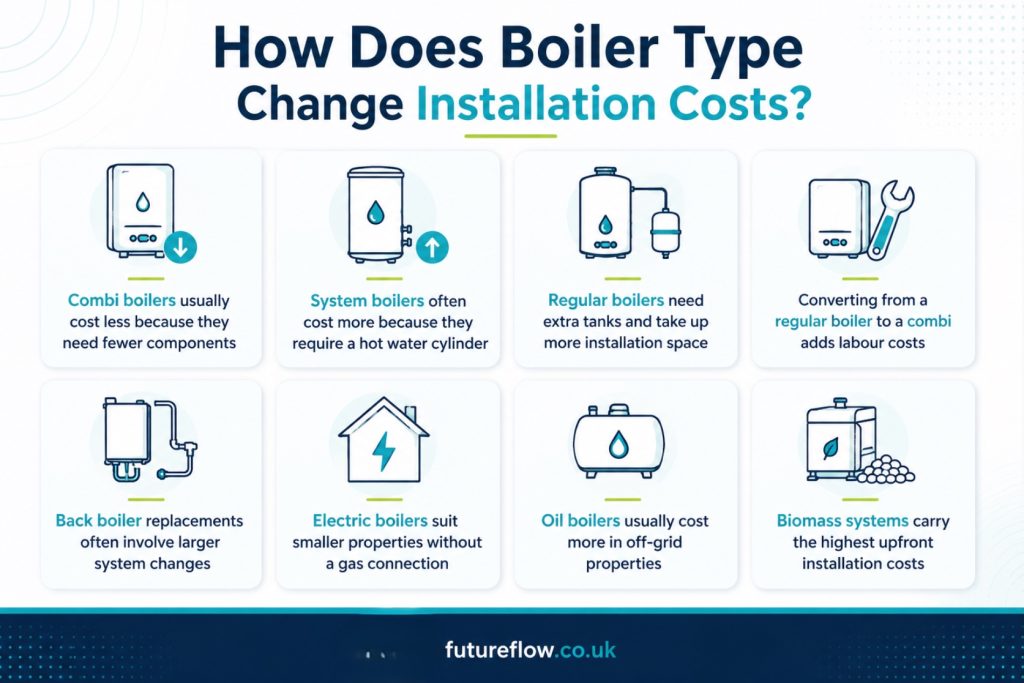
Getting the wrong type for your property creates problems later (even if the initial quote looks attractive).
Combi Boilers
Combi boilers heat water on demand without needing a cylinder or tank. They suit smaller homes and flats where space matters. Installed prices range from £1,800 to £3,500 depending on brand and output.
Combis remain the most popular choice in UK homes because they save space and work well for typical family usage.
- Pros: No cylinder needed, instant hot water, compact size.
- Cons: Lower water pressure with multiple taps running, not ideal for large homes, no backup if the boiler breaks.
System Boilers
System boilers need a cylinder but no cold water tank. They suit medium to larger homes with more than one bathroom. Installed prices range from £2,200 to £3,800.
System boilers work well when several people shower at different times or when water demand peaks.
- Pros: Better water pressure for multiple taps, cylinder stores hot water, works with solar thermal.
- Cons: Cylinder takes up space, installation costs more than combis, slower hot water recovery if the cylinder empties.
Regular Boilers
Regular boilers (also called conventional or heat-only boilers) need both a cylinder and cold water tank. They suit older homes with existing tanks and cylinders. Installed prices range from £2,500 to £4,000.
Regular boilers make sense when converting to a combi would mean replacing every radiator (which gets expensive quickly).
- Pros: Compatible with older radiator systems, cylinder provides backup hot water, works with low-pressure mains.
- Cons: Takes up most space, installation costs more, slower to heat water initially.
New boiler Cost by Brand (2026)
Brand choice affects upfront cost, warranty length, and parts availability. Premium brands cost more but typically offer longer warranties and better efficiency.
The following breakdown shows typical installed costs for a mid-range 28–30kW combi fully fitted:
| Brand | Tier | Installed Price | Warranty |
|---|---|---|---|
| Worcester Bosch | Premium | £2,800–£3,800 | 7–12 years |
| Viessmann | Premium | £2,700–£3,700 | 7–10 years |
| Vaillant | Premium | £2,600–£3,600 | 7–10 years |
| Ideal | Mid-range | £2,200–£3,200 | 5–10 years |
| Baxi | Mid-range | £2,000–£3,000 | 7–10 years |
| Alpha | Budget | £1,800–£2,600 | 5–7 years |
Premium brands cost £600–£1,200 more than budget options upfront. However, longer warranties and better build quality often mean fewer repairs over the boiler’s life. Budget brands work fine for straightforward installations where cost matters most.
How Much Does Boiler Installation Cost?
After choosing the boiler type and brand, labour becomes the next biggest cost variable. Installation timing and complexity determine the final labour charge.
Labour rates for Gas Safe engineers typically run £40–£80 per hour, depending on location. Total labour for a standard combi swap ranges from £500 to £1,200. Like-for-like swaps take 1 to 2 days.
Regular to combi conversions take 2 to 3 days because tanks and cylinders need removing. System to combi conversions also take 2 to 3 days. Moving the boiler to a different location adds another day and £300–£800.
Domestic gas work must be carried out by a Gas Safe-registered engineer by law. OFTEC registration applies to oil boilers. Unregistered installers cannot legally fit gas appliances (regardless of how cheap their quote looks).
Installation is often where the final bill rises. Unforeseen pipework issues, asbestos around old boilers, or poor access all add time and cost. We handle gas and heating services for homeowners who need reliable installation and proper Gas Safe certification from the start.
Recent inflation has pushed labour and materials costs higher across the UK. Consumer price inflation data from March 2026 shows continued pressure on service costs, which explains why installation quotes in 2026 stay higher than older estimates from 2020 or 2022.
What Affects the Boiler Cost
Several factors push quotes up or down beyond the boiler itself. Understanding these helps you compare quotes properly (rather than just picking the lowest number).
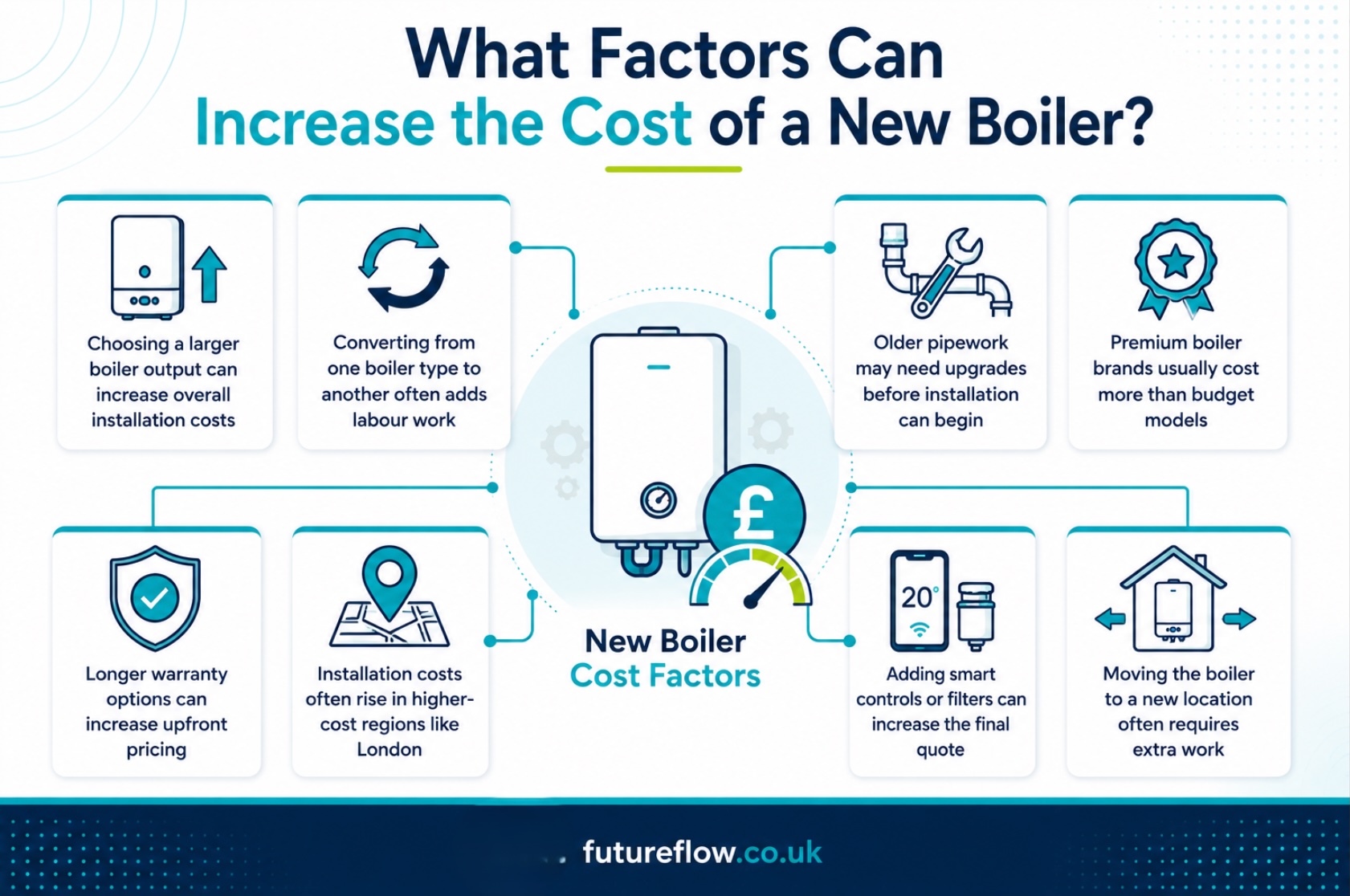
Research on boiler sizing found that oversizing above a certain threshold can create a 6–9% efficiency penalty. Case-study boilers often ran for less than 10 minutes at a time, which wastes gas and shortens boiler life. Professional sizing prevents this problem, which is why the cheapest quote is not always the best value.
What's Actually Included in a Quote
A complete quote should cover everything needed for a legal, safe, and compliant installation. Cheap quotes often miss critical items (which creates problems later).
A proper quote covers:
- Boiler unit and flue kit
- Labour and Gas Safe certification
- System flush to remove sludge
- Magnetic filter to protect the new boiler
- Controls or smart thermostat
- Old boiler removal and disposal
- Warranty registration
- Building Control notification
A £1,800 quote missing the flush, filter, and controls is not really cheaper than a £2,400 quote that includes them. The missing items cost £400–£600 to add later (plus you risk voiding the warranty if the flush gets skipped).
Grants and Schemes for New Boilers in 2026
Government grants and schemes help eligible households reduce upfront costs. Several programmes run in 2026, depending on location and circumstances.
ECO4 supports low-income households and those in fuel poverty. The scheme covers boiler replacements alongside insulation and heating upgrades. ECO4 runs to the end of 2026.
The current support available through the Boiler Upgrade Scheme includes:
- £7,500 grants for air-source heat pumps
- £7,500 grants for ground-source heat pumps
- £5,000 grants for biomass boilers in limited circumstances
- Funding secured through 2029/30
- £2,392 million in total capital funding allocated to the scheme
Since the scheme launched, 49,136 grants have been paid, with 97% going to air-source heat pumps. Average total quote amounts reached £13,433 for ASHPs and £27,924 for ground-source systems. Around 74.7% of grants replaced fossil-fuel heating systems, showing how the scheme supports the transition to low-carbon heating.
Scottish and Northern Ireland support differs from England. Local councils sometimes offer additional grants for heating upgrades. Non-eligible households can use 0% boiler finance through some installers (though terms vary).
Will Gas Boilers Be Banned?
This question comes up constantly because the messaging changed between 2023 and 2026. The answer is straightforward now.
The 2025 ban was scrapped. The phase-out of new natural gas boilers has been pushed to 2035. That phase-out applies to new builds (not replacements in existing homes). You can still install a new gas boiler in 2026 and beyond.
About 85% of UK homes are heated with a gas boiler. Around 1.5–1.7 million gas boilers are replaced each year, which shows how large and routine this market remains.
Conclusion
A new boiler costs £1,800 to £4,500 installed in 2026, with most homeowners paying £2,500 to £3,000 for a mid-range combi swap. Boiler type, brand, labour, and extras affect pricing. Proper sizing and professional installation protect long-term performance and value.
If you need a new boiler fitted or want a fixed-price quote, contact us today for expert home heating advice.
FAQs
How long does a new boiler last?
A well-maintained boiler lasts 10 to 15 years. Premium brands with annual servicing can reach 20 years.
How long does installation take?
Will gas boilers be banned?
What size boiler do I need?
Do I need a Gas Safe engineer?
Yes. Domestic gas work must be carried out by a Gas Safe-registered engineer by law.